
What Level Is a Bachelor’s Degree in the UK?
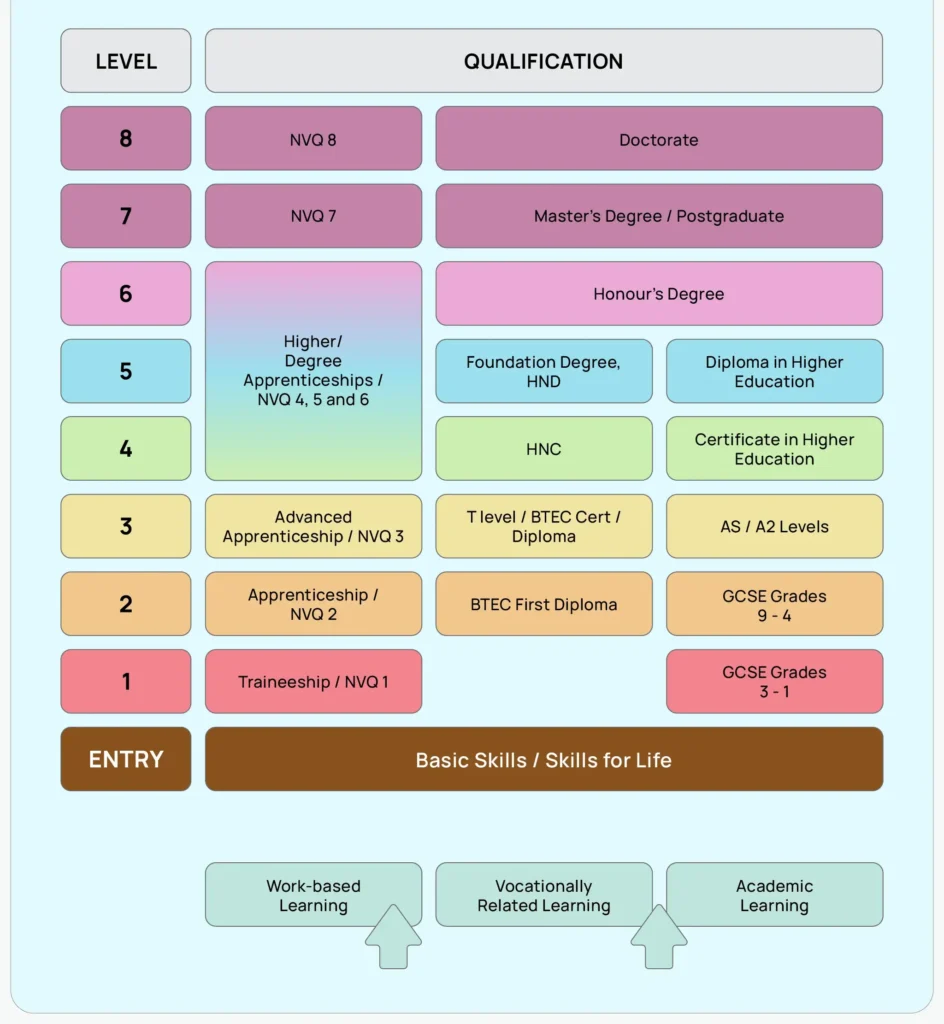
If you are wondering what level a bachelor’s degree is in the UK, the answer is Level 6 in England, Wales and Northern Ireland. This includes bachelor’s degrees with honours, such as a Bachelor of Arts (BA Hons) or Bachelor of Science (BSc Hons), as well as ordinary bachelor’s degrees without honours.
Understanding qualification levels can help you compare education options, plan your next step after university and explain your academic background to employers or educational institutions. However, a qualification’s level is only one part of the picture: the subject studied, awarding institution and course requirements also matter.
What Does Level 6 Mean?
In England, Wales and Northern Ireland, qualifications are organised into levels that indicate the complexity of the knowledge and skills involved. Generally, higher levels represent more advanced learning.
A bachelor’s degree sits at Level 6 because it involves in-depth study of a subject, critical thinking, independent learning and the ability to apply knowledge to complex questions or practical situations.
For example, a student completing a BA in Business may study management, marketing and organisational strategy. Someone completing a BSc in Computer Science may focus on programming, algorithms, software development and computing theory. Although the subjects differ, both qualifications can sit at Level 6.
You can check the official classifications in the GOV.UK guide to qualification levels.
Which Qualifications Are at Level 6?
Several qualifications are classified at Level 6 in England, Wales and Northern Ireland.
These include:
- Bachelor’s degree with honours: Examples include BA (Hons), BSc (Hons) and BEng (Hons).
- Ordinary bachelor’s degree: A bachelor’s degree awarded without honours.
- Graduate diploma: A qualification that provides advanced study, often in a particular subject area.
- Some vocational qualifications: Certain awards, certificates, diplomas and occupational qualifications are also classified at Level 6.
Not every qualification at Level 6 is a bachelor’s degree. Two qualifications can share a level without having the same content, duration, credit requirements or academic purpose.
What Is the Difference Between an Honours Degree and an Ordinary Degree?
A bachelor’s degree with honours usually involves a defined programme of undergraduate study and may include a substantial final-year project, dissertation or other advanced assessment.
An ordinary degree is awarded without honours. The precise requirements and structure depend on the university and course.
Both can be Level 6 qualifications in England, Wales and Northern Ireland, but their academic structures and award requirements may differ. If you are comparing two qualifications, check the university’s course regulations and the exact award stated on the certificate.
How Does a Bachelor’s Degree Compare With a Master’s Degree?
A bachelor’s degree is generally an undergraduate qualification, while a master’s degree is a postgraduate qualification.
In England, Wales and Northern Ireland, a bachelor’s degree is normally Level 6, a master’s degree is Level 7, and a doctorate such as a PhD is Level 8.
Here is a simple comparison:
| Qualification | Typical level |
|---|---|
| A levels | Level 3 |
| Higher National Diploma (HND) | Level 5 |
| Bachelor’s degree | Level 6 |
| Master’s degree | Level 7 |
| Doctorate (PhD) | Level 8 |
These levels refer to the relevant qualification framework. They do not mean that every qualification at one level is identical or interchangeable with another.
Is a Bachelor’s Degree Level 6 in Scotland?
Scotland uses a different system called the Scottish Credit and Qualifications Framework (SCQF). It is therefore important not to assume that the level numbers used in England, Wales and Northern Ireland apply directly to Scotland.
Under the SCQF, an honours bachelor’s degree is typically at Level 10, while an ordinary bachelor’s degree is typically at Level 9.
If you earned a qualification in Scotland or are applying to a Scottish institution, use the SCQF and the university’s official guidance when checking its level.
How Long Does It Take to Complete a Bachelor’s Degree?
Many full-time bachelor’s degrees in the UK take three years to complete. Some programmes take four years or longer, depending on the subject, university and course structure.
For example, a course may include a placement year, a year abroad or additional professional training. Certain subjects, such as medicine and architecture, can have longer study periods.
Part-time programmes also tend to take longer than their full-time equivalents. Check the course page to confirm the duration, attendance requirements and assessment structure before applying.
Does Level 6 Mean a Qualification Is Automatically Recognised?
No. A qualification’s level describes its position within a framework; it does not, by itself, prove that every institution or employer will recognise it for a particular purpose.
If you need a degree for employment, further study or professional registration, check the requirements of the organisation making the decision. You may need to confirm the awarding institution, the precise qualification, the subject studied and whether any additional professional requirements apply.
For qualifications from outside the UK, recognition depends on the qualification and the organisation assessing it. You can consult UK ENIC for information about international qualification comparisons.
Frequently Asked Questions
Is a bachelor’s degree Level 6 or Level 7?
A bachelor’s degree is generally Level 6 in England, Wales and Northern Ireland. Level 7 is the level normally associated with master’s degrees.
Is a BA the same level as a BSc?
Generally, yes. A Bachelor of Arts (BA) and Bachelor of Science (BSc) are both bachelor’s degrees and are normally Level 6 in England, Wales and Northern Ireland. Their subjects and academic requirements differ.
Is an HND equivalent to a bachelor’s degree?
An HND is generally Level 5 in England, Wales and Northern Ireland, while a bachelor’s degree is Level 6. Some universities allow HND holders to apply for a top-up programme, subject to entry requirements.
Can I use a Level 6 qualification to apply for a master’s degree?
A bachelor’s degree is a common route into master’s study, but admission depends on the university’s entry requirements, your grades, subject background and any additional criteria. Not every Level 6 qualification automatically meets the entry requirements for every master’s programme.
How can I check the level of my qualification?
Start with the awarding institution and the official qualification framework relevant to where the qualification was awarded. If you need it for a job, professional registration or university application, ask the receiving organisation what evidence it requires.
Need Guidance on Your Degree or Academic Documents?
Need guidance about your degree or replacement academic documents? Contact Buy Authentic Degree for help with the appropriate next steps.
Final Thoughts
A bachelor’s degree is generally a Level 6 qualification in England, Wales and Northern Ireland, placing it above Level 5 qualifications such as an HND and below Level 7 master’s degrees. Scotland uses a separate framework, so the relevant level number differs.
If you are comparing qualifications, applying for further study or explaining your academic background to an employer, always check the exact award and the requirements of the organisation that needs to recognise it.